
Learning & Information
Partnerships
Blockchain Monitoring Tools Customized to Precision
Aug 11, 2026 | 3 min read
The strongest risk mitigation approach involves customizing and combining multiple tools and services to align with your specific needs, operational environment, and risk tolerance. The way we approach these evolving needs at zeroShadow is that we keep a working view of the monitoring market landscape and match the tool to the problem. We have deployed custom solutions across Hypernative, Tenderly, and Range to ultimately save millions in dollars in vulnerable funds.
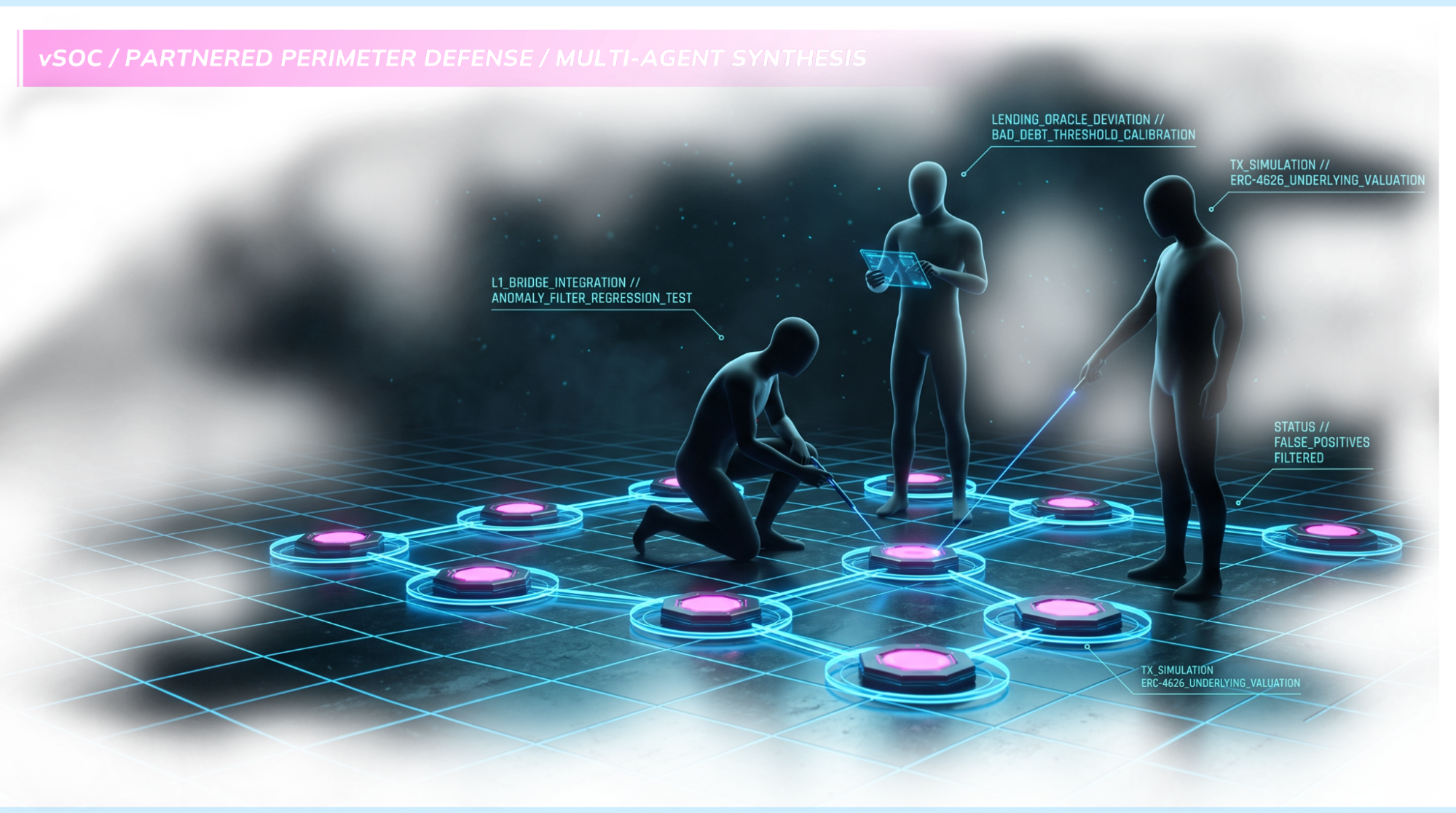
Real time monitoring is often perceived as a single product a user or team can switch on, but in actuality, the right setup looks very different for a Layer 1 chain than it does for a lending market or a trading firm.
- A blockchain foundation cares more about bridge inflows and outflows, validator anomalies, and large treasury movements.
- A lending protocol typically cares more about oracle deviation, bad debt, and flash loan driven exploits.
- A trading firm typically cares more about its own wallet activity and the specific contracts it touches.
In our experience, no single tool can address every security priority on its own, off the shelf. In most cases, the strongest risk mitigation approach involves customizing and combining multiple tools and services to align with your specific needs, operational environment, and risk tolerance.
The way we approach these evolving needs at zeroShadow is that we keep a working view of the monitoring market landscape and match the tool to the problem. Over H1 2026, we evaluated and deployed across three platform providers, each with their different strengths:
- Hypernative gives broad, chain wide coverage and custom agents across EVM and non-EVM networks, and both retail and enterprise enhanced wallet security.
- Tenderly handles transaction simulation, state-differential comparisons, and incident war rooms. These simulations can be especially important for ERC-4626 vaults, which may promise a certain return but the simulation proves that the underlying amount is truly different.
- Range traces cross-chain interchain flows with a specialty for non-EVM chains and also specializes in stablecoin monitoring.
For most clients, the answer is not a single vendor but a primary platform with one or two others filling specific gaps for a maximization of coverage.
The value we add from zeroShadow is the nuanced fine-tuning. Some off-the-shelf agents will either miss things that matter to a given protocol, or bury the team in false positives until they stop reading the alerts. We work directly with partner engineering teams to:
- Write and refine custom monitoring in their development language,
- Set thresholds against each protocol's real economic model,
- Regression test alerts against historical state before they go live.
Custom monitors in action
As an example, for one L1 partner, the large majority of monitoring is concentrated on a single bridge integration, because that is where their actual risk sits, rather than spread evenly across every contract they own.
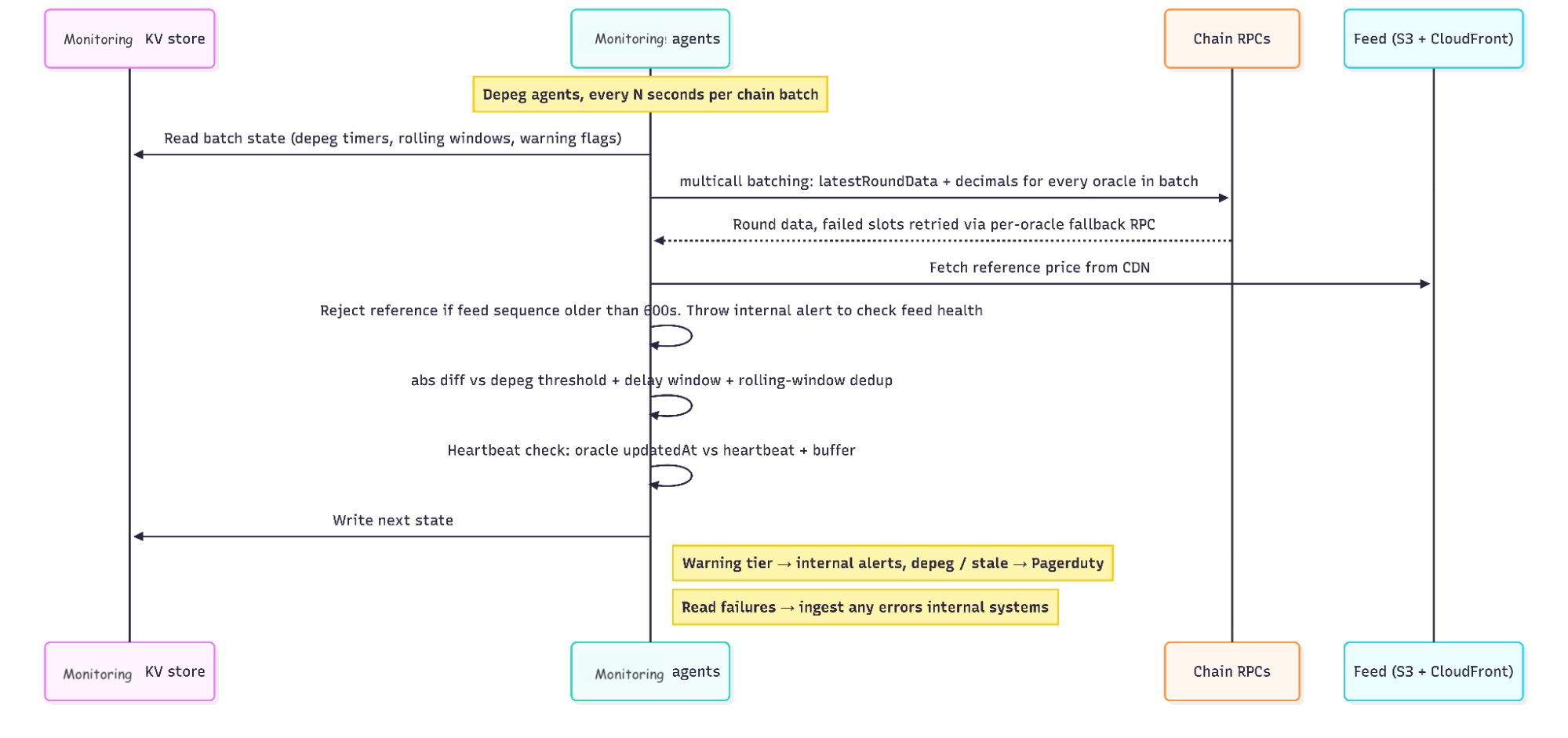
In another example, a native asset deviation monitor fired 142 false mismatches while the custom agent, running on our aggregated price feed, fired 0 at the time of this post. The gap is not in the code quality, it’s data sourcing. The native monitor leans on third-party price aggregators and the platform's own RPC infrastructure. When a node sticks on a stale block or old block, the monitor can read an old price and fire a depeg alert on a market that is behaving normally. Our custom agent cross checks the oracle contract’s on-chain state against an independent price feed we wrote which aggregates from the highest liquidity sources before it alerts. If the two agree, then the alert is real and if they disagree nothing fires and your team keeps working.
Extending your security
Ultimately, these types of monitors can be combined with wallet security considerations and Incident Response playbooks to extend security off the blockchain. In one recent instance, zeroShadow saved $4M of vulnerable funds by identifying a multisig wallet that required different module logic. With recent exploits like the SquidRouterModule permissionless "multicall" function and the vault contagion risk shown by the depegging of USR or rsETH, it's clear that such focus is timely.
Great tooling is only as good as its calibration. If you want a precision perimeter defense that definitely matches your protocol's risk profile, let's build it.